
On September 23, 2019, Sholem Dolgoy, an associate professor and former chair of production at Ryerson University’s School of Performance, retired. He taught at the school since the early 1980’s while building a towering career in lighting design in Canadian theatre and dance. I recorded the presentation that night and present here to you the juiciest bits of that evening, including an addendum to our talk from Episode #13 of the The Title Block. We recap Sholem’s career, how he got into teaching and his efforts to laud the word of theatre administrators in a time when we need them most.
Thank you, Sholem, for being a mentor to so many great artists, and we wish you all the best on your next adventure!
Special Presentations
Special Pres: 1837 The Farmers' Revolt Panel Discussion /

William Lyon Mackenzie (Matthew Gin), with help from his assistants Marcia Johnson (left) and Parmida Vand uses his magical deck of cards to explain the relationships in the Family Compact, in 1837: The Farmers’ Revolt at the Blyth Festival. Directed by Gil Garratt. Creative team: Beth Kates, set, projection and lighting designer; Gemma James Smith, costume designer; and Deanna H. Choi, sound designer and music composer. Production stage management: Heather Thompson and Katerina Sokyrko.. Photo credit: Terry Manzo.
A little palate cleanser for the end of the summer. On July 18 2018, at the Huron County Museum, Blyth Festival artistic director Gil Garratt and local historian David Yates sat down with moderator and film director Christopher Spaleta to talk about the history around Blyth's current production of 1837: The Farmers' Revolt. We talked about this play during the episode with designer Rachel Forbes and the production last year at the Shaw Festival. This is more of a historical discussion, rather than one about design, but it is still a great talk about politics and privation and standing up to government, a topic no less germane today than it was 130 years ago.
A special thanks to Beth Kates who coordinated and recorded this event, without whom this presentation would not be found here.
Bios
Gil Garratt
Gil Garratt is a director, playwright, dramaturge, Dora Award-winning actor, and theatre administrator who has worked across Canada and internationally. With a career that has been dedicated primarily to the development of new Canadian plays, Gil has been with the Blyth Festival since 1999.
Gil’s varied and eclectic career as a creator has seen him collaborate with such radical play creation companies as DNA theatre and The Cabaret Company, to such mainstream institutions as The Stratford Festival and The Grand Theatre.
As a performer Gil has literally worked all over the country, including: Theatre NorthWest in Prince George, BC, Centaur Theatre in Montreal, Canadian Stage’s St. Lawrence Centre in Toronto, Shakespeare in High Park, Neptune Theatre in Halifax, the Festival Players of Prince Edward County, Buddies in Bad Times in Toronto, the Royal Manitoba Theatre Centre in Winnipeg, and the National Arts Centre in Ottawa, to name a few.
Gil is also member of the Playwrights’ Guild of Canada, several of Gil’s plays have received multiple productions, toured internationally, and been translated into French.
David Yates
David is a 28 year history teacher currently at Central Huron Secondary School in Clinton.
Since 2007 his local history column has appeared in The Focus, Goderich Signal Star and other local papers. He is a past President of the Huron County Historical Society.
In 2014, he was a member of the Great Lakes Storm of 1913 committee which won the Governor-General’s Award for Community History Programming. Currently, he is a member of the Huron County and the Great War commemorative committee.
Christopher Spaleta
Christopher is a writer, actor and director for independent film, television and theatre. He grew up in Goderich, studied English and Screenwriting in Ottawa, and lives with his wife Maria on a farm in Central Huron. In addition to his duties on the Huron Arts and Heritage network board he is a member of the Rebuilding Oversight and Steering Committee for the reconstruction of the Square in Goderich.
Special Pres: PACT's Digital Dramaturgy /
This time a special presentation that I happen to catch at the last minute about digital dramaturgy. The teleconference was recorded on April 25, 2018 as a presentation of the Professional Association of Canadian Theatre. The panel discussion is an result of an idea by the artistic practice committee of PACT and centres around the role and dramaturgy of projections in theatre. Designer Beth Kates and artistic director and playwright Gil Garratt from the Blyth Festival speak with Theatre Projects Manitoba artistic director Ardith Boxal and director, writer, and arts educator Health Davies about how to successfully integrate projection into a live theatre production.
Bios
Jeremy “Boomer” Stacey - professional development manager PACT
Jeremy “Boomer” Stacey, has been working on PACT PD since joining the office in 2010 – just in time to work on the Conference in Cow Head, NL. Aside from work in event production and professional development, Boomer also has a wide range of experience in international performing arts for young audiences. In addition to PACT he works as International Performing Arts for Youth’s (IPAY) founding Executive Director, works on the board of ASSITEJ Canada (Treasurer) and sits on the Pickering Rouge Canoe Club (Commodore). Prior work includes the Artistic Directorship of the renowned Milk International Children’s Festival of the Arts at Harbourfront Centre in Toronto. Boomer holds a BFA, visual arts, specializing in photography. He lives just outside Toronto with his wife, boy, girl, dog & cats and the occasional raccoon but has started the slow move to the cabin in the woods in Northern Ontario.
Beth Kates - designer
Beth Kates is an award winning Theatrical Lighting, Set, Costume and Projection Designer, Production Manager, and project consultant. She is the co-Creative Director/Designer of Playground Studios a design firm she started with partner Ben Chaisson that is dedicated to creating new spaces, re-inventing the use of traditional and non-traditional theatre spaces, as well as producing original work and offering a full spectrum of design and project management services.
Her work in rock and roll, dance, theatre, opera, and photography has taken her across Canada, the US, UK, Europe, New Zealand and Australia. Career highlights include Lighting Design: Spurt of Blood and Miinigoowezewin (Banff Arts Festival), Anaconda (Tangent Montreal), the Dora Award winning Music For Contortionist (Shaw Festival and Tarragon Theatre), and numerous works by choreographer Learie McNicols. Set Design for the award winning production of Assassins directed by Adam Brazier; Production Design for: the world premiere of Judith Thompsons’s Such Creatures directed by Brian Quirt, LuminaTO/Tapestry New Opera Works’ epic oratorio Dark Star Requiem directed by Tom Diamond, and Julie Tepperman’s Yichud (Seclusion). Yichud was an extensive design that required re-imagining the use of the traditional theatre space to allow the whole building to be converted into a realistic Orthodox Jewish Synagogue.
Beth’s work as a Projection Designer began in 1995, and over the years she has become a self taught Video Editor, Videographer, Photographer, Graphic Designer, and Animator in order to facilitate the creation of various projects. As the Resident Production Designer for WYRD Productions, she has created designs for Slightly Bent, MacHomer, Into The Ring, Bigger Than Jesus, and HARDSELL. Bigger Than Jesus earned Beth the 2005 Dora Award for Outstanding Lighting Design. In 2009 she, along with husband Ben Chaisson, was nominated for the prestigious Siminovitch Prize in Theatre. Beth and Ben were also recently cited as one of Toronto’s Top Ten Theatre Artists by NOW Magazine.
Gil Garratt - artistic director, The Blyth Festival
Gil Garratt is a director, playwright, dramaturge, Dora Award-winning actor, and theatre administrator who has worked across Canada and internationally. With a career that has been dedicated primarily to the development of new Canadian plays, Gil has been with the Blyth Festival since 1999.
Gil’s varied and eclectic career as a creator has seen him collaborate with such radical play creation companies as DNA theatre and The Cabaret Company, to such mainstream institutions as The Stratford Festival and The Grand Theatre. As a performer Gil has literally worked all over the country, including: Theatre NorthWest in Prince George, BC, Centaur Theatre in Montreal, Canadian Stage’s St. Lawrence Centre in Toronto, Shakespeare in High Park, Neptune Theatre in Halifax, the Festival Players of Prince Edward County, Buddies in Bad Times in Toronto, the Royal Manitoba Theatre Centre in Winnipeg, and the National Arts Centre in Ottawa, to name a few. Gil is also member of the Playwrights’ Guild of Canada, several of Gil’s plays have received multiple productions, toured internationally, and been translated into French.
Gil graduated from the National Theatre School’s Playwriting Program in 1998, holds an Honours BA from the University of Waterloo, and an MA from the University of Guelph.
Ardith Boxall - artistic director - Theatre Projects Manitoba
Artistic Director Ardith Boxall is an actor and director. In 2005, after a year as associate artist, Ardith was appointed the Artistic Director of Theatre Projects Manitoba, a company dedicated to new plays and the development of local artists. Prior to this, she worked primarily as a freelance actor for stage, film and television, a drama instructor, and was an emerging director. A graduate of the University of Winnipeg with an honours degree in Theatre and Drama, Ardith continued her studies at the National Voice Intensive at Simon Fraser University, and mentored in directing under several of Manitoba’s finest theatre practitioners.
Since the company’s founding by Harry Rintoul and members of the community in 1990, Ardith has maintained strong ties with Theatre Projects. Several acting, assistant directing and directing credits at TPM over the years have reinforced the need to preserve the Company as a professional theatre for artists in our region. Selected TPM credits include Ce Weekend la, Live With It, I Do…Do You? The Monster Trilogy, Age of Arousal and three instalments of In the Chamber (2006, 2007 and 2009).
Heather Davies - director, writer, educator
Heather Davies was born in Winnipeg, Manitoba and grew up in Toronto, Ontario. She's trained as a dancer, singer, actor and musician and has worked professionally since her teens. Heather moved to the UK to continue her actor training; she lived and worked in theatre there for 18 years. In 2001 she began focusing on directing full-time when she joined the Royal Shakespeare Company as a resident director, working there for nearly three years. She returned to Canada in 2007 to attend the MFA- Theatre program at York University, graduating in April 2009. From September 2009 to February 2011 she was the Artistic Associate at The Grand Theatre in London Ontario. She continues to enjoy directing, writing, teaching and adapting in the UK and across Canada. Highlights of 2017 included becoming the first Artistic Director of The Ryga Festival, (inspired by renowned Canadian writer, George Ryga) in Summerland, BC and directing Colours in the Storm at the Grand Theatre in London, Ontario. In 2018, as well as returning to Summerland, Heather's stage adaptation, Judith: memories of a Lady Pig Farmer, (original novel, Judith, by Alberta writer Ardith Van Herk), will premiere at the Blyth Festival. Other projects in development include Silverfish (an original play about economic migration) and the stage adaptation of Night Desk, (novel by George Ryga). She is represented by Ian Arnold at Catalysttcm.com Email: ian@catalysttcm.com
#14 Disappearing Act: A Public Forum on Canadian Theatre and Toronto Audiences /
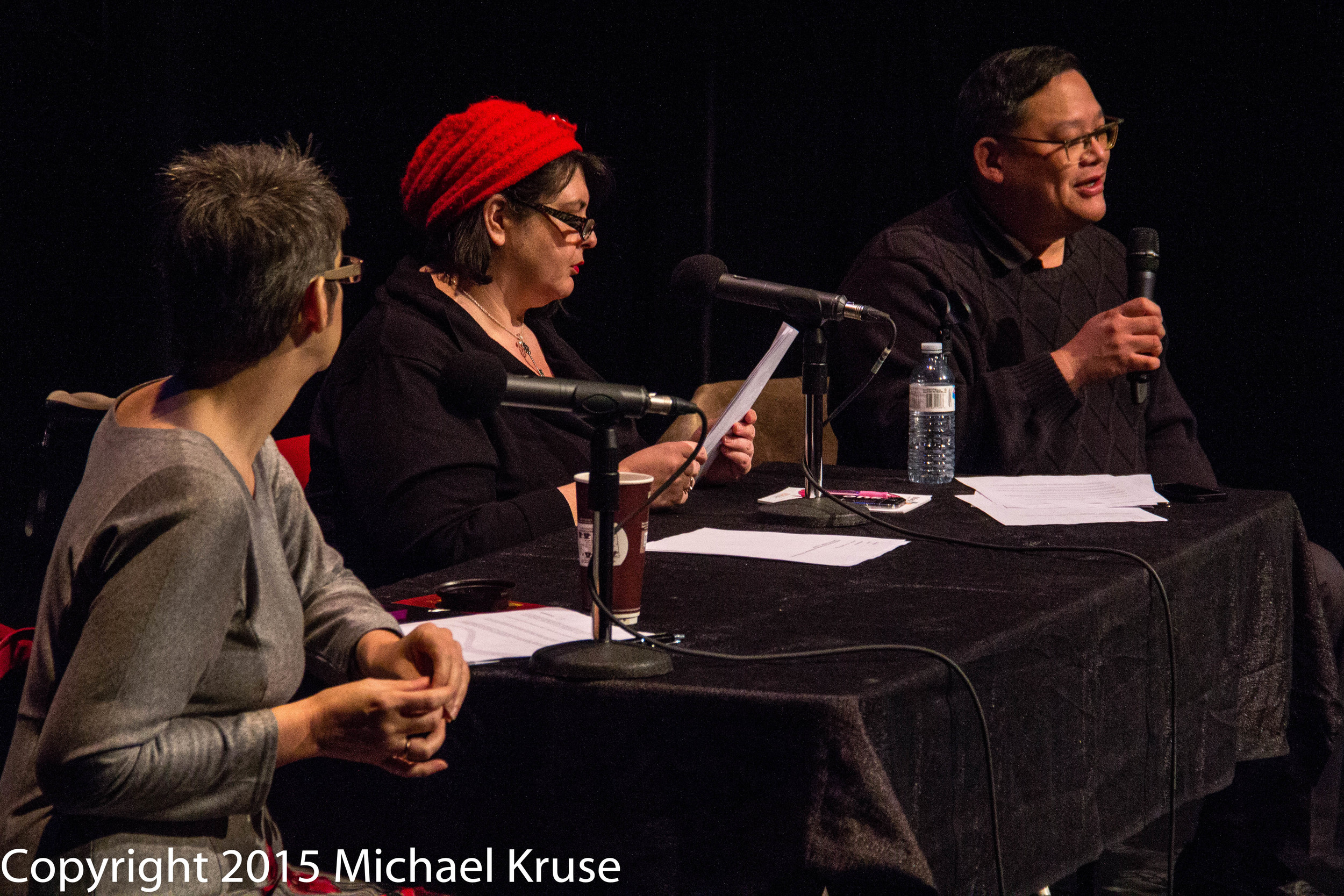
From Left to Right: Sheila Sky, Sue Edworthy, Derrick Chua
This episode started with a random conversation on Facebook in December of 2014. Three weeks later, on January 11, 2015, a forum on the crisis of audience building was held at Theatre Passe Muraille in Toronto, Ontario. The organizers were Sheila Sky, a talent agent and the executive director of the Associated Designers of Canada, Derrick Chua a prolific theatre producer and Sue Edworthy a marketing and communications director. The audience was made up of artists, producers, board members, patrons, critics and creators, and the format was to pose questions that were collected and collated by Sue and Sheila to the audience and have those stakeholders try to come up with answers to the question of how to save the modern theatre audience.
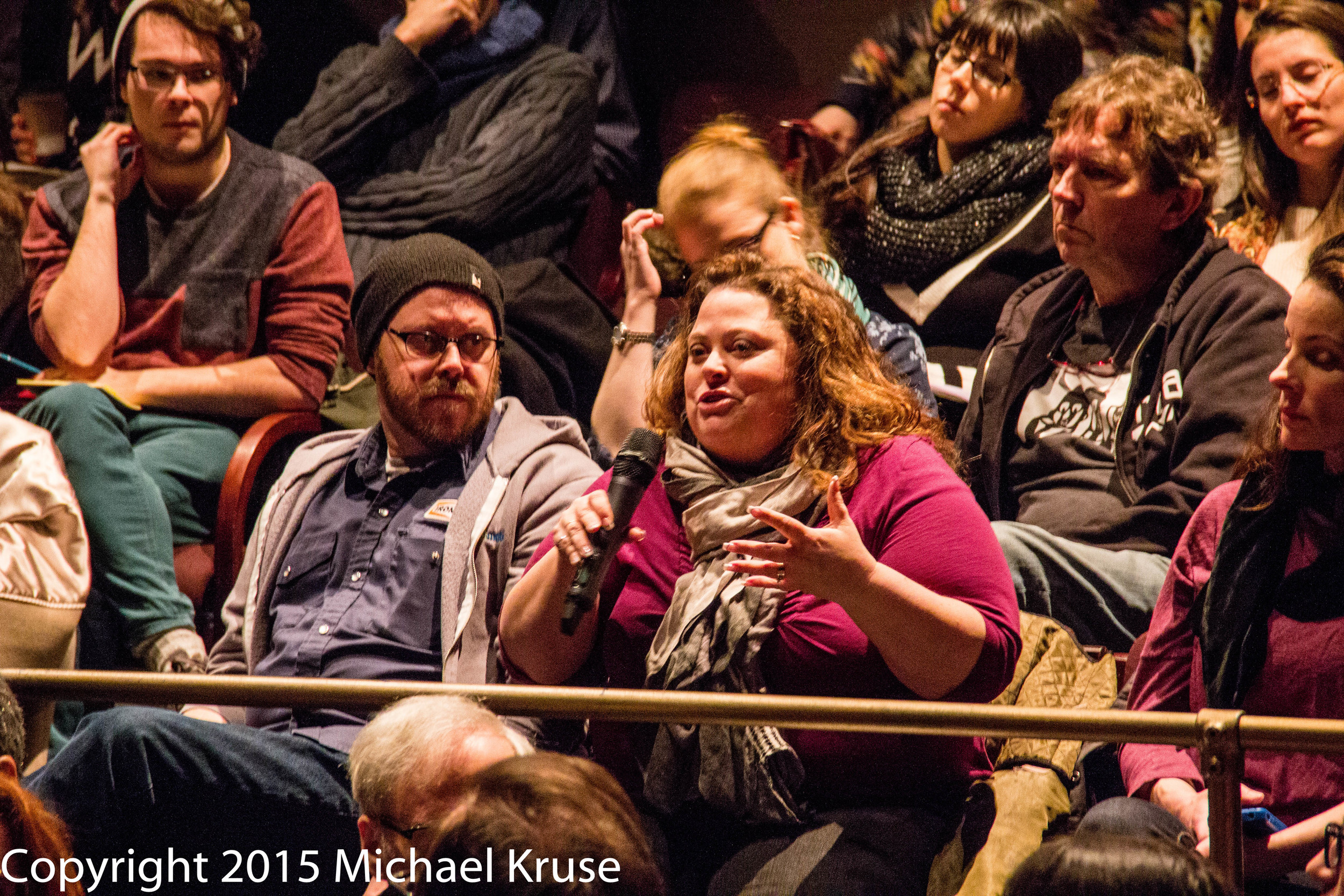
Theatre critic and founding editor of Mooney on Theatre, Megan Mooney
This conversation will delight some, confound many, and anger others. There are no answers here, but there is the start of a much needed conversation about how we make theatre relevant in a world that is dominated by me-too stars of YouTube and entertainment-at-your-fingertips on Netflix. However, before you listen, I would like to add my two cents to the conversation first.
Most theatre artists in English Canada (and here I am ignorant of the amateur theatre scene in Quebec so I will not even try to characterize it) first engaged with live performance at the local amateur level. Be it in a stuttered, naive scene study in grade 10 drama, or a lavish musical theatre society production, most of us reveled in the thrill of stepping, painting, plugging, or barking for the first time in front of our peers and family in the community: and we could not get enough of it.
This theatrical movement in many communities is decades older than the modern professional theatre in Canada that I am trying to document here on The Title Block. This movement, which includes operetta groups and Sears Drama Festival retinues, is still a strong and vital part of many smaller communities, while us here in the big smoke of Toronto make have forgotten it. In North Bay or Nanaimo, community theatre not only attracts all ages and talents, but it sells; boy does it sell. Community theatre continues to sell and draw in volunteers and talent because the stakes are high and the thrill is palpable, for both the performer and the audience.
Professional theatre audiences have changed; I think we can agree on this. There is the dying breed of "blue hairs" as we dismiss them, callously. They are aging, and soon we will be left with a hole. "We need to attract the youth!" is the cry but no one, or most, have not a clue on how to do so. This forum will show that. But there is hope, and here is my proposition.
Today's 30 year old does not engage in entertainment passively. They want to be active participants. Maybe not in the original creation, but they tweet, post, blog, heckle, flame, praise, text, and all in a media cycle that pushes each of them further and further apart. There are fewer people attending church; it is a wonder that we make any connection at all given that there are more ways than we have ever thought of to "other" and push people away. More than anything, your 30-year old wants to be in a community. They want to feel a part of it. More importantly and specifically, they want to be in on the joke.
No one likes to be left out of the joke, even if they are the butt of it, everyone wants to have the inside skinny, the special treatment. YouTube, if it has done anything, it has sold us the idea that anyone can have a special talent and be popular; that stardom or fame is accessible. That may be fantasy, but that does not mean that your 30-year old stops wanting it: they even expect it.
Is this right? I have no idea, but this is the case, and we can take advantage of it while creating at the same time. There were several hints about this possibility in the forum. Some of successes spoken about in Disappearing Act are those that built an audience from scratch and have succeeded by building a community around their art. Some let the audience guide the choice of season, some create spaces in which the audience can interact with artists to share ideas and connect on a human level with the ideas presented in the play. Exit subscribers. Enter subsumers. Build community.
We cannot continue to remain a viable entertainment option, or heaven forfend a machine of change, if we continue to ignore the audience and see them as passive consumers let alone have contempt for them when they "don't get my art". Another common theme in the forum was "make good art!" and that is important, but we cannot "make good art" to serve our own egos, we have to do it for our audience, our conspirators: our community.
Until this forum, I thought that "boutique" theatre may be an answer. An exclusive and expensive, as well as an expansive, evening that used the art as a centre-piece, but that added extras in to make it special. Well, now I think that was naive: we have to use the art as a way of talking to one another, and let the poetic conversation bleed into the before- and after-time of the experience and blend with the prose of our audience. We need to create community.
Remember that thrill of stepping onstage for the first time? You thought that either you were going to pass out or persevere, but either way you were going to get the lines out in front or your friends and try to tell them why you love this so much. We need to keep that feeling inside of us when we create theatre. We have to stop being the weird cousin of Canadian culture and show our community that we matter, that art matters, and that theatre is not our own little, elite toy that the audience "can play with when we are done with it" but rather that it is how we tell our stories, and "won't you come along and tell me yours."
We need to build community. Our livelihood depends on it, and our audience is waiting.
Rant over, audio below.
Links
Join the Disappearing Act Facebook Group
STAF: Open Source Brainstorm
Associated Designers of Canada
#10 Projection and the Future Part 2 /
This episode picks up at the second half of the panel discussion about projection and the future of design at the Canadian Institute of Theatre Technology's annual conference, Rendez-Vous 2014. I am once again joined by Scott Spidell, Eric Mongerson, Beth Kates, and Ben Chaisson (bios can be found at episode #9).
We started the talk about the unique funding challenges of buying or renting equipment that advances so quickly, move on to talk about the language of video in a production and end with a discussion about copyright and planning for the future.
Links
Toronto Association for the Performing Arts
#9 Projection and the Future Part 1 /
This is a long one, but well worth it. On August 16th, 2014, I traveled to Ottawa, Ontario for the Canadian Institute for Theatre Technology's annual trade show Rendez-Vous 2014. There, I led a panel discussion about the use of projections in theatre design with Scott Spidel, Eric Mongerson, Ben Chaisson and Beth Kates. Thankfully, CITT had booked our discussion for 3 hours and despite the fact that we thought we would be done early, we went right to the 3 hour mark. It was a very comprehensive discussion as you will see (this is part 1 of 2!). Bios and links for the show are below.
Bios
Scott Spidell
Scott Spidell, is an assistant professor in production design and technical direction at Texas Lutheran University. He has been a professional theatre artist and craftsperson for over thirty years. Over that time, he has worked in almost every aspect of theatre, film and television—from driving and loading tour trucks, writing scripts for TV shorts, working sound on a Papal tour, serving as a tailor's apprentice, performing as an Equity actor, and getting shot by Charles Bronson— to working as a professional carpenter, scenographer, video designer, camera assistant, lighting designer, props master, producer, and union stage manager.
He has been an active director of the Ontario Section of the Canadian Institute for Theatre Technology (CITT) and the president of the board of Inter Arts Matrix, a non-profit that fosters the development of integrated art. Scott has also taught at the Universities of Waterloo, Guelph, Windsor, Ryerson and Fanshawe College.
He last designed the lights, set, and video for The Resistible Rise of Arturo Ui by Bertolt Brecht for the red light district theatre in Toronto and the lighting for Mirror – a chamber opera for soprano and visual artist for the Open Ears Festival in Kitchener.
Scott has a Diploma of Applied Arts in Technical Theatre from Niagara College, a Bachelor of Environmental Studies with a minor in Drama from University of Waterloo, and an MFA in Performance Design from York University in Toronto.
Eric Mongerson
Eric Mongerson worked in and studied theatre in the United States for ten years before moving toMontréal in 1980. In addition to serving as full professor at Concordia University he works as set/lighting designer and technical director outside the university. He received his MFA from Humboldt State University in 1978.
He received Social Sciences and Humanities Research Council of Canada (SSHRC) funding as a co-investigator with Dr. Stephen Snow on “Performance-based Research: Changing Perspectives on Developmental Disabilities through Ethnodrama”.
He has taught set and lighting design, stage management, theatre administration and theatre technology.
He has consulted for Scénoplus and Cirque du Soleil on equipment installation and theatrical problem solving. He has designed lighting for many productions across North America. At Concordia he has served as Technical Director, Theatre Manager, Production Coordinator, Design for the Theatre Coordinator and Chair of the Department from 1993 - 2002.
His students have designed for, Broadway, Cirque du Soleil and Stratford. He has been on the board of directors of the Canadian Institute for Theatre Technology / L’Institut Canadien des Technologies Scénographiques (CITT / ICTS) and is currently on the board of the Centre Québécois de L’Institut Canadien des Technologies Scénographiques (CQICTS). He is a member of the Association des Professionnels des Arts de la Scène du Quèbec (APASQ). He received the Dieter Penzhorn Award in 2011 from CITT and the MECCA award for best lighting design in Montreal in 2010.
Ben Chaisson and Beth Kates and Playground Studios
Ben Chaisson and Beth Kates are the co-creative directors of Playground Studios, a firm dedicated to creating beautiful productions for the entertainment industry. Beth and Ben are award winning designers of projection, lighting, sound, costume and set for dance, theatre, opera, rock n roll and many other live events.
Most recently their interactive installation The ToyBox was awarded the CITT Award for Technical Merit, their newest installation Night Light Travels saw 1400 participants at this year’s Scotiabank Nuit Blanche, and Ben was awarded the 2010 Pauline McGibbon Award for emerging designers. They and their work have toured the world. Theatrical highlights include MacHomer, Bigger Than Jesus (Dora Award for Lighting), Hardsell, The Highest Step In The World, Anne of Green Gables, Spin, The Synesthesia Project with Steven McCarthy, Brimful of Asha with Ravi Jain and many more.
Beth and Ben lead masterclasses in Projection and Scenographic Design across the country. They are currently in development with Playwrights Workshop Montreal to create a series of in-depth projection workshops geared towards established theatre artists, with the intention of helping them gain a deeper understanding of this growing medium. Beth has lead masterclasses for students at Humber College, Bishop Strachan School and The National Theatre School, and Canadian Stage.
Check them out at www.playgroundstudios.ca